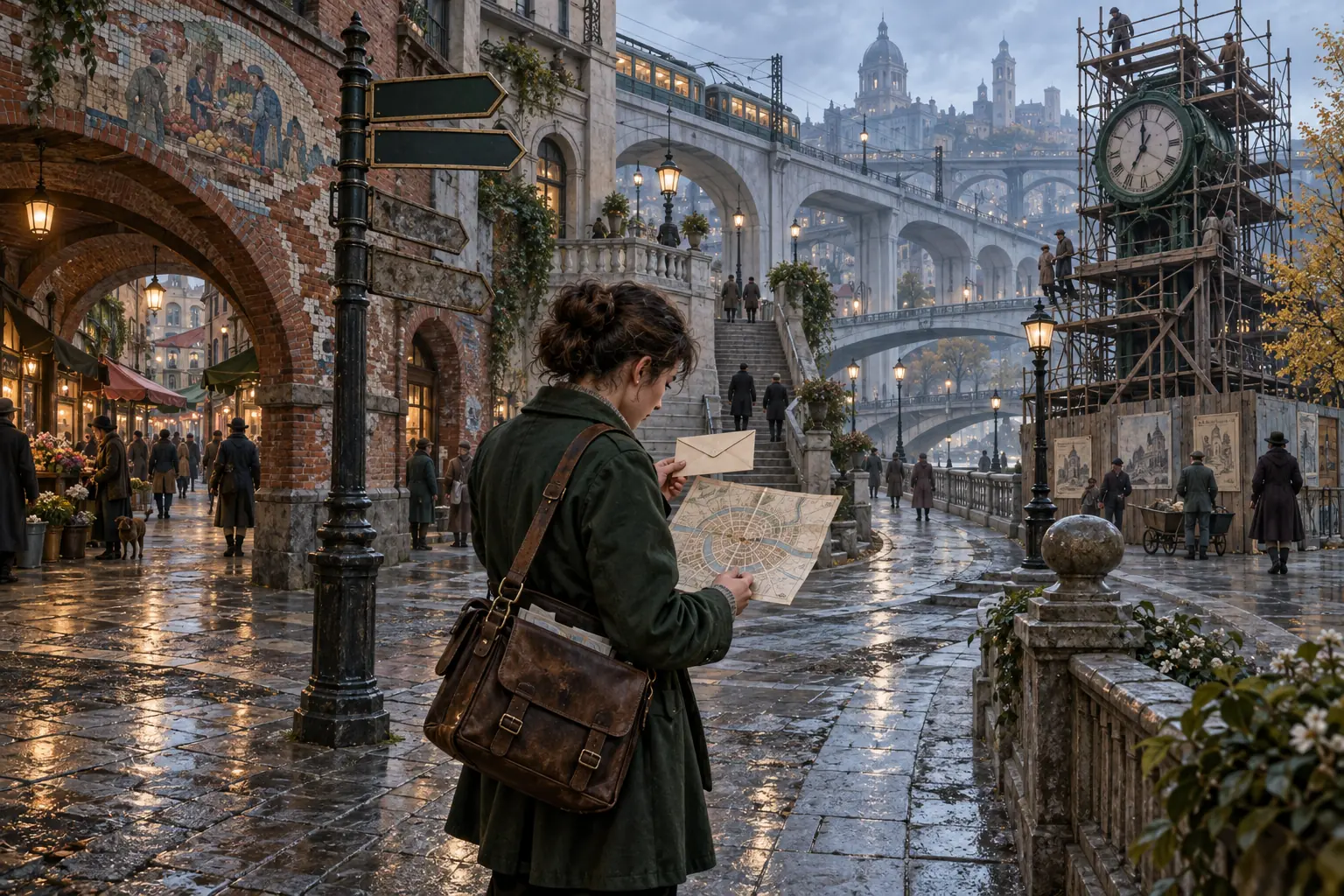
By regulation, a letter addressed to nobody belonged in the furnace.
Mara Senn found it on top of the morning returns, a cream envelope among the grey notices and unpaid invoices. The sorting machine had stamped it UNRESOLVED. Beneath the stamp, someone had written four careful lines by hand:
NOBODY. UNDER THE GREEN CLOCK. AFTER THE THIRD MOVE. WESTMARKET.
Westmarket had not appeared on an official map for nine years. The city had divided it between the Conservatory Exchange, the River Steps, and three levels of tramway. Its green clock had been removed when the square became a ventilation shaft.
Mara carried the envelope to her supervisor. Enzo read the address twice.
“No recipient,” he said. “No current location. No return mark.”
“There is a route.”
“There is a riddle.”
He placed it in the red furnace tray. Mara lifted it out again.
For twelve years she had delivered through street renamings, bridge closures, and the quarterly revisions that made yesterday's map look like an accusation. People still wrote to kitchens that had become clinics and rooms that now hung above railway cuttings. Usually the city left a forwarding record.
Usually the record ended after the second move.
Enzo looked at the clock. “End of shift. Then it burns.”
∗ ∗ ∗
The green clock stood inside scaffolding beside the River Steps. Its hands had been removed, but rain still gathered in the brass numerals. A restoration worker named Daro was eating an apple beneath it.
“Westmarket?” he said. “You want the old square, not the clock.”
“The address says under the clock.”
“It has been under three clocks.”
He led her to a brick arch buried beneath the new tram concourse. A mosaic of fruit sellers survived above it, interrupted by white tiles where a support beam had cut through the picture.
“After the clearance, this was the relocation desk,” Daro said. “People collected keys here, if the new rooms were ready.”
They had not been ready for everyone. Thirty-one residents slept in the shuttered market hall for six months. The housing registry required each address to have a named leaseholder, but the residents shared the rooms, the cooking, and the appeals. They refused to choose one person whose claim would outrank the others.
A clerk had entered NOBODY in the mandatory field and bolted a blue mailbox beneath the clock. Against expectation, the post began to arrive.
“When they moved us to the old baths, the box went too,” Daro said. “That was the first move. The school gym was second.”
“And the third?”
He pointed uphill, beyond a row of new glass offices. “Loom Hall. Unless the city has found another use for it.”
Loom Hall had become a print cooperative. Presses thumped where cots had once stood. The woman at the front desk remembered the blue mailbox but not where it had gone.
A printer wiping ink from his hands heard them talking. “It never left,” he said. He pulled aside a folding noticeboard. Behind it, set into the wall, was a narrow metal door painted over so many times that the blue survived only at the hinges.
Mara tried the envelope. It fit through the slot.
“That proves there is a box,” she said. “I still need somebody authorized to receive it.”
The printer smiled. “Then come back at six.”
∗ ∗ ∗
At six, nine people unfolded chairs around the presses. Some had lived in Westmarket. Others were their children, or neighbors from the baths, or volunteers who kept the weekly meal downstairs. A woman named Tavi wore the mailbox key on a cord beneath her shirt.
“Nobody was never a person,” Mara explained. “The post needs a recipient.”
“Nobody was the recipient,” Tavi said. “That was the point.”
She unlocked the box. It contained three takeaway menus, a notice about a pipe inspection, and a marble a child must have pushed through the slot. Tavi placed the cream envelope on the table without opening it.
The others arrived at no quick agreement. One man said a nameless letter could belong to anyone and therefore to no one. A younger woman said that was also how the city had treated their old address. Daro, who had followed Mara uphill, suggested they vote as they used to.
The envelope was opened by nine hands holding one paper flat.
It came from Arel Voss, who had been eleven during the months beneath the clock. Now she worked in the municipal archive. She had found the Westmarket relocation ledgers in a disposal list: names, temporary room numbers, and the forwarding addresses that had failed to enter the official map. The archive would release copies only to a recognized successor organization.
Arel did not know which former resident still held that role. So she had written to all of them.
The group read the letter twice. Then Tavi signed Mara's custody slip: NOBODY, LOOM HALL, COLLECTIVE DELIVERY POINT.
Enzo was still at his desk when Mara returned. He examined the signature, Daro's account of the three moves, and an old route card the group had kept inside the box.
“The name is not registered,” he said.
“The route exists.”
He glanced toward the furnace tray. Then he opened the alias register and gave Nobody a postal code.
The following week, four envelopes arrived for Loom Hall. One came from the archive. Three were replies to Arel, each carrying a different return address across the revised city.
Mara bound them with green string and placed them in her delivery bag. Outside, workers were installing another set of street plaques. The map would change again. This time, the route had somewhere to go.