The first complaint said District Twelve was too quiet.
Yara Venn assumed somebody had selected the wrong category. Then she opened the civic sound map and found a white square where the district should have been. For forty-six hours, its public microphones had registered no usable sound at all.
At the boundary, a delivery tram crossed in front of her. She saw its wheels grind against the wet rail. The noise stopped as neatly as if a door had closed.
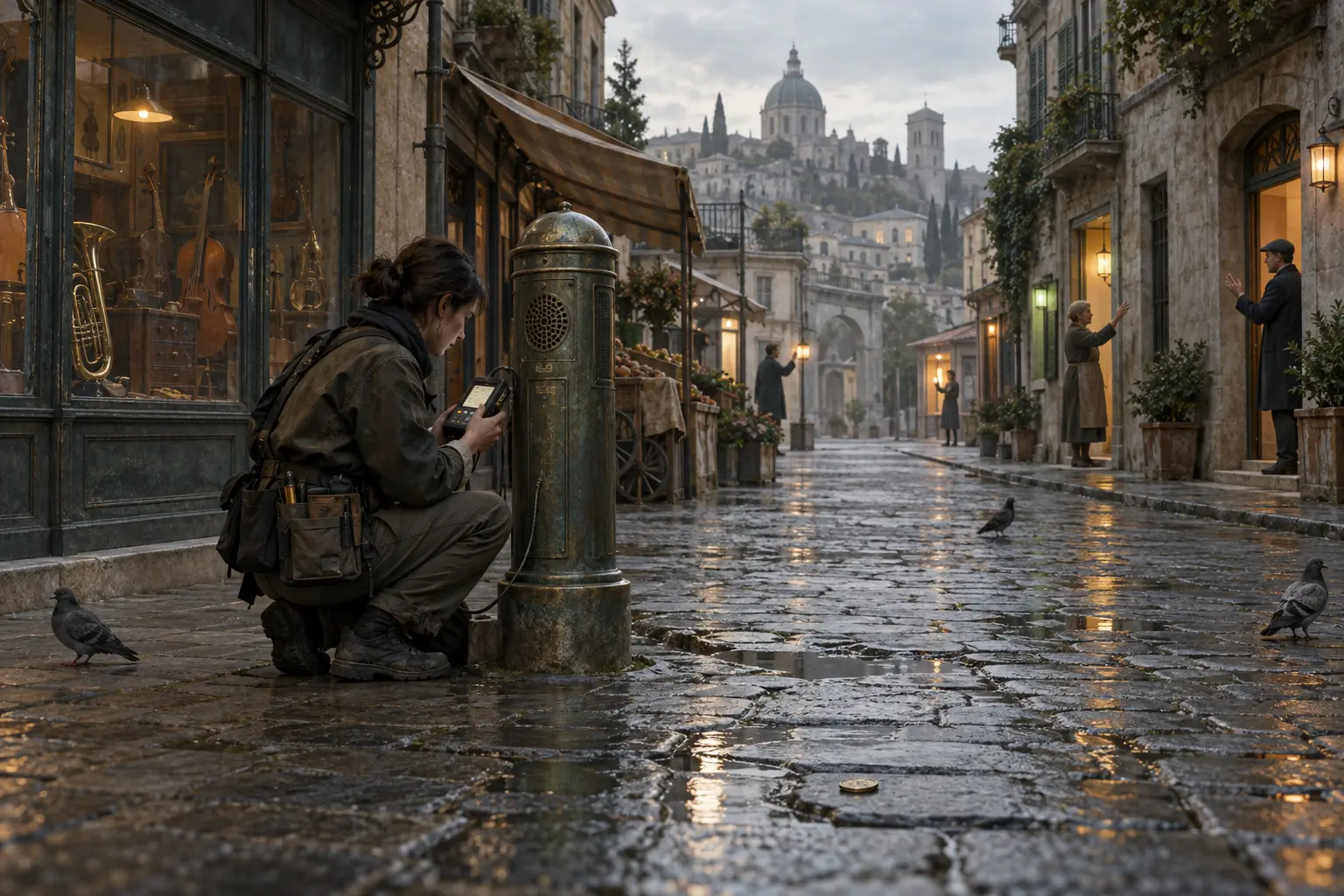
Inside the district, Yara heard her own breathing through bone and little else. A brass coin slipped from a fruit seller's hand. It struck the stones without a click. The seller pointed to it, and a customer bent to help.
Doorway lamps flashed green as people entered shops. Cyclists wore vibrating bands that warned them when a tram approached. Conversations moved in quick hands, paper notes, and patient eye contact.
A grey-haired man unlocked an instrument shop and beckoned Yara inside. Violins and horns crowded the window like objects in a museum.
He wrote on the back of a receipt: YOU ARE LATE.
Yara showed him her city badge and wrote beneath it: WHEN DID IT START?
He turned the receipt over. WE SOLD THE NIGHTS. THEY TOOK THE MORNINGS.
His name, printed on a drawer label, was Saye. He led her to the nearest acoustic pylon. Yara connected her meter and watched the machine build an opposite wave for every sound the street produced. The cancellation field was functioning perfectly.
It was the schedule that was wrong.
District Twelve had voted two years earlier to suppress street noise from ten at night until six in the morning. Under the city's acoustic exchange, each verified hour of quiet became a credit. The North Arc entertainment quarter bought those credits to keep its theatres, clubs, and late trams louder after midnight.
Twelve used the money to build a flood wall. The arrangement was strange, but it was not a secret, and the vote had passed by a wide margin.
The contract on Yara's screen still said eight hours. The pylons had been ordered to produce twenty-four.
∗ ∗ ∗
Yara called Central Acoustics from the unsuppressed side of the boundary. Her supervisor, Pell, answered over the sound of an office kettle.
“Storm continuity clause,” he said. “Their transformer failed on Monday. The grid defaulted to maximum production.”
“The transformer came back Tuesday morning.”
“And North Arc has a festival permit based on the additional credits. If you reduce production now, the permit fails.”
Yara looked through the invisible boundary. Saye was demonstrating a cello bow to a child who could not hear the string.
“Emergency tones are being cancelled.”
“They have visual alarms.”
“They voted for quiet nights.”
Pell was silent long enough for the kettle to switch off. “The wall payment is due tomorrow. Break continuity and Twelve loses this month's transfer. Leave the cluster alone until the renewal hearing.”
The hearing was that afternoon. District representatives could attend through a public terminal in the library. Yara crossed back and explained on Saye's receipt, using arrows where her sentences would not fit.
She expected him to ask her to shut the pylons down. Instead, he wrote: IF YOU CHOOSE FOR US, HOW ARE YOU DIFFERENT?
Yara disliked the question because it was fair.
Saye unlocked a cabinet beneath the pylon. The verification microphones were inside. They did not merely measure silence; they sent proof of it to the exchange. Raw sound travelled out through a maintenance channel before the pylon cancelled it in the street.
Yara looked toward the library. The hearing terminal used the same municipal network.
She drew a microphone, a cable, and the council chamber. Saye read the sketch twice. Then he smiled and began knocking on doors.
∗ ∗ ∗
At four, the renewal board saw the usual white square on its wall: District Twelve, fully compliant, every quarter-hour certified silent.
Yara opened the maintenance channel.
The chamber filled with ordinary noise.
A baker struck a spoon against a mixing bowl. A mechanic ran a bicycle bell under his thumb. Children recited the street names. Somebody dragged a chair. Somebody else laughed too early and made several others laugh with them.
Saye played one sustained note on the cello. It wavered, steadied, and held.
Then the residents spoke together, close to the verification microphones.
“We sold the nights,” they said. “You sold the rest.”
The white square on the board broke into red. Across the city, North Arc's excess-noise permit suspended automatically. Pell sent Yara three messages she did not read.
The hearing lasted two hours. Some residents wanted the entire exchange abolished. Others wanted the original contract preserved; the flood wall had kept water out of their kitchens that spring. They argued loudly once Yara disabled the daytime schedule, and nobody mistook the disagreement for failure.
The board suspended the continuity order. It restored the ten-to-six contract, exempted every emergency signal, and charged the missing wall payment to the city reserve while the unauthorized credits were investigated. North Arc's festival could continue, but its outdoor stages had to close at midnight.
Yara received a formal reprimand for rerouting a verification channel. Saye framed a copy beside his till.
Two weeks later, she returned to calibrate the repaired pylons. The market sounded untidy and alive: shutters, bargaining, a radio with a damaged speaker. In the instrument shop, the child drew a clean note from the cello and frowned at the result.
Saye adjusted the child's grip. At ten, the doorway lamps changed from green to blue. Shopkeepers lowered their voices. The pylon softened the last tram as the district entered the silence it had actually chosen.
This time, everyone had heard the yes.