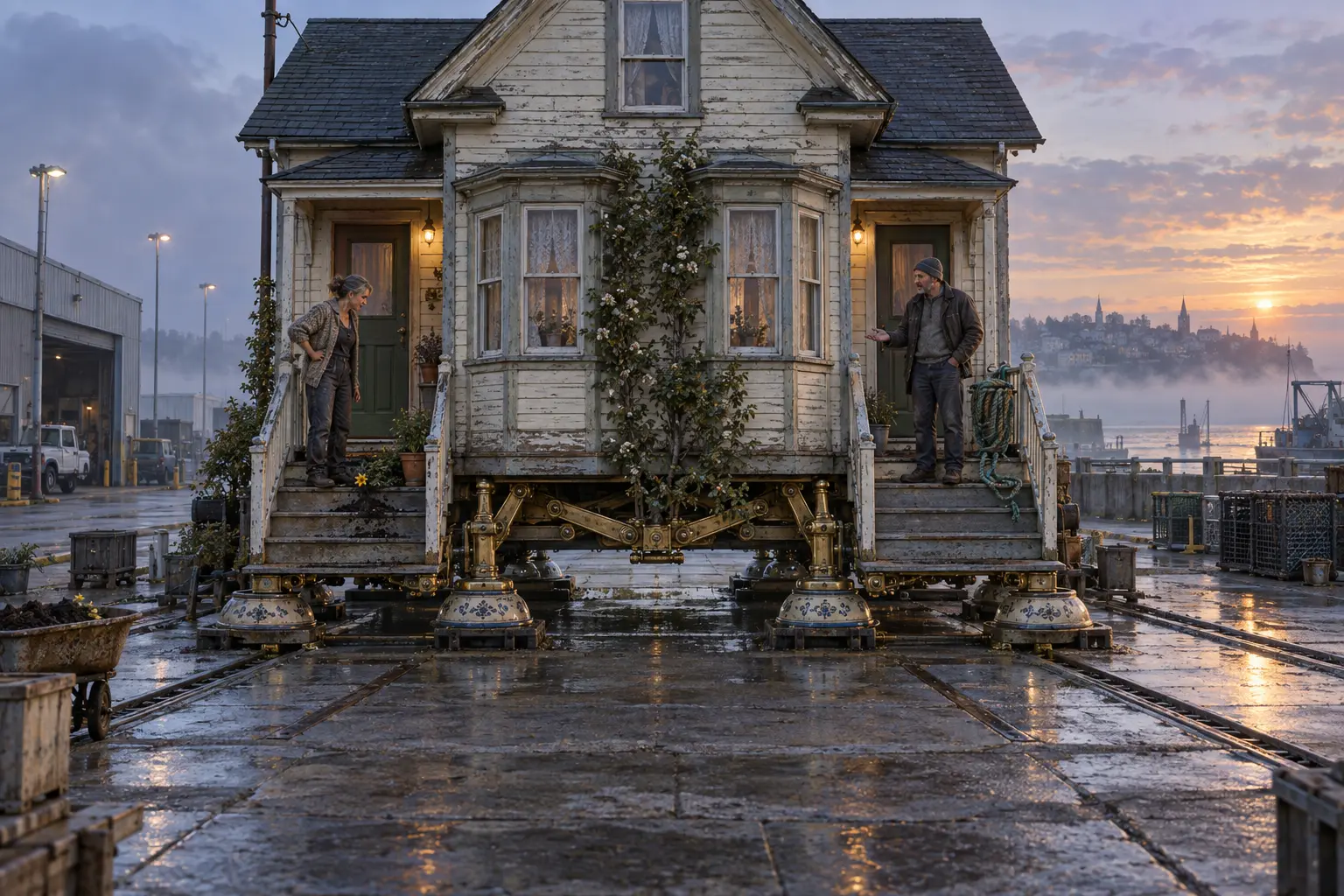
At dawn, Number Twelve unfolded.
Nemi woke to crockery leaning against the cupboard doors and the deep brass groan that usually passed beneath the house too softly to disturb anyone. A strip of blue light appeared along the bedroom floor. Then the walls settled with a sigh.
She went downstairs expecting to open her door onto Orchard Steps: saffron plaster, greenhouse roofs, the pear seller arranging his crates. Instead she found a wet service yard, six empty rails and a municipal shed with its shutters down.
Across the front garden, Calder stepped from the other door in his socks.
“What have you done?” they asked together.
For eighteen years they had shared Number Twelve's central wall, roof, pipes and narrow back hall. Nemi's front rooms belonged to Orchard Steps. Calder's opened onto Salt Quay, three kilometres downhill. A hinge foundation folded the distance between the two addresses, allowing one old house to stand in both neighborhoods at once.
Now both doors opened onto the same yard.
“We were at Orchard yesterday,” Nemi said.
Calder pointed to his railing. A coil of green harbor rope had caught around the post. “We were at the quay.”
Nemi showed him the dark soil packed beneath her step and a yellow blossom crushed against the threshold. “Then where did these come from?”
“Where did that come from?” He touched salt drying white across his window.
They had disagreed about repairs, gutters and whether his radio could be heard through brick. They had never before disagreed about where they lived.
∗ ∗ ∗
The hinge mechanic arrived after eight, carrying a case of ceramic gauges. Her name was Rusk. She crawled under the shared hall while Nemi and Calder stood on opposite porches, guarding their evidence.
“Both of you are right,” Rusk called from beneath the house. “Yesterday the east anchor held Orchard. West anchor held Salt Quay. At 5:42, the hinge plate cracked. The safety system unfolded the structure and brought it to neutral ground.”
Calder looked pleased for half a second, until he understood that being right had solved nothing.
Rusk emerged with blue powder on her sleeves. Replacement plates were grown to match each foundation. The queue was eight months. Until then, Number Twelve could hold one anchor, not two.
“Choose by sunset,” she said. “I can return the house to either address. If you don't choose, it stays here.”
Nemi's workshop occupied her front room. Three apprentices came through the Orchard door each morning carrying cracked lenses and bent garden instruments. Calder repaired tide clocks for the ferry crews. The quay bell was close enough to set every clock in his rooms vibrating on the hour.
“The house was built in Orchard,” Nemi said.
“The quay paid for the hinge after the flood,” Calder said.
“That doesn't make this your house.”
“I didn't say mine.” He looked toward the shared wall. “You did.”
∗ ∗ ∗
They spent the afternoon trying to measure belonging.
At Orchard Steps, Calder watched Nemi's apprentices waiting under the greenhouse awning with their tool rolls. The pear seller had covered her door with canvas as if the house were merely being repaired. A child had placed a note where the step had been: BACK TOMORROW?
At Salt Quay, Nemi found two ferry mechanics drinking tea beside the empty rectangle Calder's rooms had left behind. One had brought a tide clock wrapped in a towel. The quay bell rang, and every loose screw inside the clock answered.
Neither visit made the choice easier. That was its value.
Back in the service yard, they sat in the shared hall. The room was only wide enough for a bench, an umbrella stand and the marks where both households had measured visiting children. It had no window onto either neighborhood.
Calder found an old brass plate beneath the bench. MOBILE CIVIC STRUCTURE, it read. Number Twelve's foundation had once carried a school between temporary flood camps before the city granted its two permanent anchors.
When Rusk returned, Nemi handed her the plate.
“Could it travel again?”
“With one anchor at a time.”
Calder unfolded the ferry timetable from his pocket. “Then give it a route.”
Rusk warned them what that meant. The house would spend alternate weeks at Orchard and the quay. Deliveries would go to collection boxes. The dawn transfer would rattle shelves, and anyone who forgot the schedule might arrive at a rectangle of empty paving. Neither household would possess the convenience it had yesterday.
Nemi thought of the note beneath her missing step. Calder looked at the tide clock still wrapped on his table.
“Alternate Mondays,” Nemi said.
“At dawn,” Calder agreed.
∗ ∗ ∗
The first move took place a week later. Rusk locked the cupboards, drew the curtains and sounded a small bell before the foundation lifted onto its rails.
Nemi and Calder waited in the shared hall. The bench shivered beneath them. For nine minutes the two doors opened onto darkness while the hinge carried one address toward the other.
When the house settled at Salt Quay, Calder's ferry mechanics were waiting with the repaired tide clock. Nemi's apprentices arrived on the uphill tram an hour later, complaining about the climb and admiring the harbor light on their lenses.
The following Monday, the pear seller stacked crates outside Calder's door at Orchard Steps. He protested until Nemi reminded him that the front garden was shared.
By the third move, both neighborhoods kept the timetable. People still asked where Number Twelve really belonged. Nemi and Calder gave different answers, but they no longer tried to make one answer defeat the other.
At each dawn transfer, they met in the windowless hall and held the crockery steady. The house had lost the trick of being in two places at once. It learned, with their help, how to keep returning.