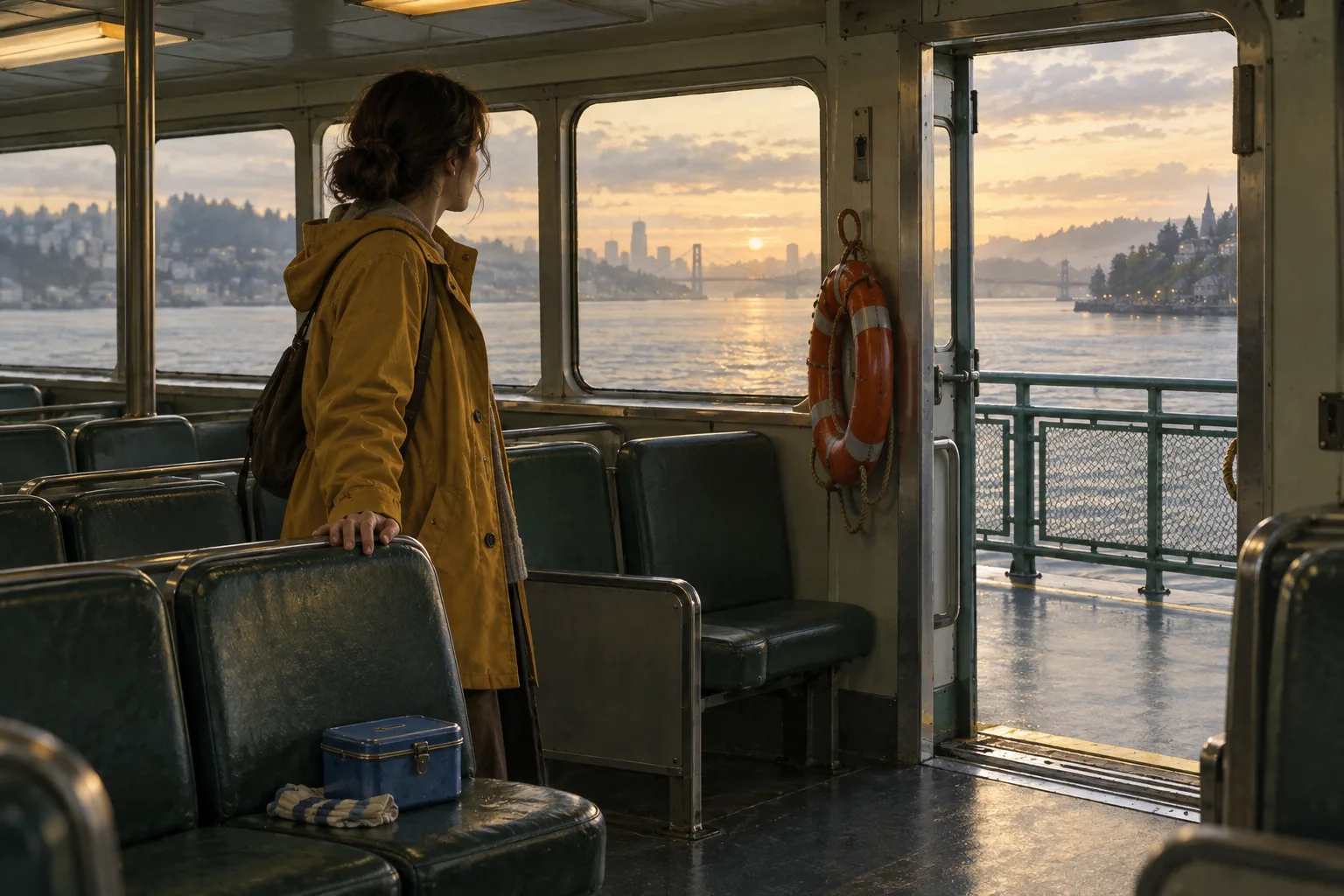
Ada remembered the river before she reached it: the taste of diesel, the cold inside her sleeves, a man's wedding ring cutting into her palm.
She was standing at her kitchen sink. Both hands were dry.
In the memory she had hauled him against an orange rescue float while someone above them shouted, “Hold there.” Beyond his shoulder, the ferry's departure board read TUESDAY 15 SEPTEMBER.
Her phone said Monday the fourteenth.
She missed the first ferry examining her hands. On the second, she found the man sitting beneath the evacuation diagram, eating a pear over a blue lunch tin.
“Do we know each other?” he asked.
She had been staring at his ring.
“I don't think so.”
“That's usually cheaper.” He moved his bag so she could sit.
His name was Pavel. He maintained the lifts in the offices across the river. Ada entered delivery invoices in one of them. They had crossed together for years without speaking.
She asked whether he travelled on Tuesdays.
“Unless somebody finally builds a bridge.”
She tried to find a sensible way into the rest. Pavel folded the pear stalk into a tissue and waited.
“I think you're going to fall overboard tomorrow.”
He looked toward the window. The water was flat, almost oily.
“Right,” he said. Then he moved his lunch tin between them.
∗ ∗ ∗
At work, the memory continued past the rescue. A deckhand wrapped Ada in silver foil. Pavel kept apologising about her coat. She could feel the heavy wet hem dragging at her knees, though her coat hung dry behind her chair.
She wrote everything down. Orange float. Torn cuff. Upper stern deck. A loose gate banging twice. Pavel reaching for something she couldn't see.
After work she took the list to the ferry office.
The supervisor, a woman called Bell, read it without smiling.
“Did you see that gate loose?”
“Not yet.”
“I need to put something in the report.”
Ada watched Bell's pen hover over the little box. “You can put that a passenger asked you to check it.”
Bell did. She asked a deckhand to inspect the gate at the next docking. Ada stayed until he returned: the upper catch wasn't engaging. The lower one held, but he had taken the deck out of use until it could be repaired.
“Good that you noticed,” Bell said.
Ada nearly corrected her. Instead she asked which ferry would run in the morning.
∗ ∗ ∗
Pavel was waiting by the ticket machine on Tuesday. He held up her list, which Bell had shown him after Ada described the man with the blue tin.
“You could have said about the gate.”
“I didn't remember that part when we spoke.”
“You remember things in instalments?”
“Apparently.”
Above the gangway, the date matched the memory. Ada's stomach tightened.
Pavel studied the ferry. “I've asked my apprentice to start without me. We can take the bus round.”
It was the solution she should have suggested yesterday. It ought to have made her feel better.
But passengers were already boarding. A teenager wheeled a bicycle up the ramp. A woman carried a large glass bowl under a towel. Any of them could go through a gate.
“I'll just check they've kept the deck closed.”
“I'll wait here,” Pavel said. “Don't miss the bus proving something.”
Bell stood at the foot of the stairs. A red barrier blocked them; the deck above was empty.
“New catch arrives at ten,” she said.
Ada gripped the stair rail. She remembered the applause when she climbed back aboard. Someone asking her name. For years she had crossed this river so quietly that even Pavel hadn't recognised her. In that other crossing, people made room for her. Bell brought her tea with both hands.
Now Bell needed to check tickets, and Ada was in the way.
“Is there something else?”
Ada shook her head. She stepped back onto the quay before the ramp lifted.
From shore, the crossing looked impossibly small. The ferry passed the grain warehouses, then the moored dredger. Ada waited for it to stop. Beside her, Pavel peeled the lid from his tin and offered her a biscuit.
The ferry reached the far bank. Nobody fell.
She could still remember saving him.
∗ ∗ ∗
They were twenty minutes late. At the bus stop Pavel called his apprentice and explained which cupboard held the service keys. Ada messaged her manager. Neither explanation included the river.
“Sorry about your coat,” Pavel said when he put his phone away.
Ada turned so sharply he drew back.
“In your list. You said it tore.” He pointed. “It looks all right to me.”
She ran a finger over the intact cuff. She had been hoping he remembered too. That would have given her somebody to talk to about the water.
“It is,” she said.
Pavel shut his lunch tin. “Will you be on the usual boat tomorrow?”
She tried to remember. There was nothing: no river in her throat, no voices, no hand in hers.
“I expect so.”
“I'll keep you a seat.”
When the bus arrived, Ada let him board first. His coat caught briefly on the door. He freed it himself, and she followed him upstairs.